WHOLE HOME WATER CONDITIONING SYSTEMS
How Our Whole Home Water Conditioning System Works
At Bradley Water Products, we’ve designed our Whole Home Water Conditioning Systems specifically for Arizona water. Rather than relying on a single filtration technology, our systems combine multiple advanced treatment media that work together to improve water quality, reduce contaminants, and help protect your home’s plumbing system and appliances.
Each gallon of water passes through a carefully engineered multi-stage treatment process, with every stage performing a specific job.
Stage 1 – Sediment Filtration
Water first passes through a 5-micron sediment filter that captures sand, dirt, rust, silt, and other suspended particles before they enter the treatment system.
Removing sediment helps protect the filtration media, extends system life, and improves overall filtration efficiency.
Stage 2 – Advanced Carbon & KDF Filtration
Next, the water flows through a specialized filtration tank containing Catalytic Carbon, Premium Coconut Shell Activated Carbon, and KDF® Media. These three technologies work together to provide broad-spectrum filtration.
Catalytic Carbon
Catalytic carbon is specially engineered to remove contaminants that standard activated carbon struggles to reduce.
It is highly effective at reducing:
- Chlorine
- Chloroform
- Chloramine (used by many municipal water providers)
- Hydrogen sulfide (rotten egg odor)
- Many volatile organic compounds (VOCs)
- Unpleasant tastes and odors
Premium Coconut Shell Activated Carbon
Premium coconut shell activated carbon features an extremely fine pore structure that adsorbs a wide variety of contaminants while improving the taste and odor of your water.
It helps reduce:
- Chlorine
- Unpleasant tastes and odors
- Many organic compounds
- Chemicals that negatively affect the taste and smell of drinking water
KDF® Media
KDF® is a high-purity copper-zinc media that uses a natural oxidation-reduction (redox) process to help reduce certain contaminants while protecting the carbon media.
KDF helps reduce:
- Chlorine
- Water-soluble lead
- Mercury
- Nickel
- Chromium
- Soluble iron (where present)
- Hydrogen sulfide
KDF also helps inhibit the growth of bacteria within the filter media and extends the life of the carbon by reducing chlorine exposure.
Together, these three filtration technologies produce cleaner, fresher, better-tasting water throughout your entire home.
Stage 3 – Advanced Salt-Free Scale Protection
After filtration, the water enters our descaling stage, where Filtersorb® SP3 Natural Assisted Crystallization (NAC) technology—and, on applicable systems, polyphosphate technology—work together to help protect your plumbing system from scale buildup.
Filtersorb® SP3 (NAC)
Unlike a traditional salt softener, NAC technology does not remove calcium and magnesium from the water.
Instead, as water passes through the media, hardness minerals are converted into microscopic, stable crystals that remain suspended in the water. These crystals are much less likely to attach to plumbing, fixtures, water heaters, and household appliances as hard scale.
Polyphosphate Technology
On systems equipped with polyphosphate, this technology provides an additional level of protection by helping keep hardness minerals dispersed in the water, reducing their tendency to bond together and form scale.
Polyphosphate can also:
Help reduce staining associated with low levels of dissolved iron and manganese Help reduce corrosion by forming a microscopic protective layer inside metal plumbing systems.
Together, NAC and polyphosphate create a highly effective, salt-free approach to scale control that helps protect your home’s plumbing and appliances without regeneration, electricity, or wastewater.
Stage 4 – Final Polishing Filter
Before the conditioned water enters your home’s plumbing system, it passes through a final 5-micron post-filter.
This final stage captures any remaining fine particles and provides an additional level of protection, ensuring clean, conditioned water is delivered throughout your home.
The Result
Our multi-stage water conditioning systems are designed to provide far more than basic filtration. By combining sediment filtration, advanced carbon technologies, KDF media, Filtersorb® SP3, and polyphosphate (where applicable), we treat multiple water quality concerns in one complete system.
Benefits Include:
Cleaner, fresher tasting water throughout your home
Reduced chlorine and chloramine
Reduced unpleasant tastes and odors
Reduction of many volatile organic compounds (VOCs)
Reduction of certain heavy metals
Reduced hydrogen sulfide odors
Salt-free scale protection
Reduced staining from low levels of iron and manganese
Improved protection for plumbing, fixtures, water heaters, and appliances
No salt to purchase
No electricity required
No regeneration cycles
No wastewater discharge
Low maintenance operation
Designed for Arizona Water
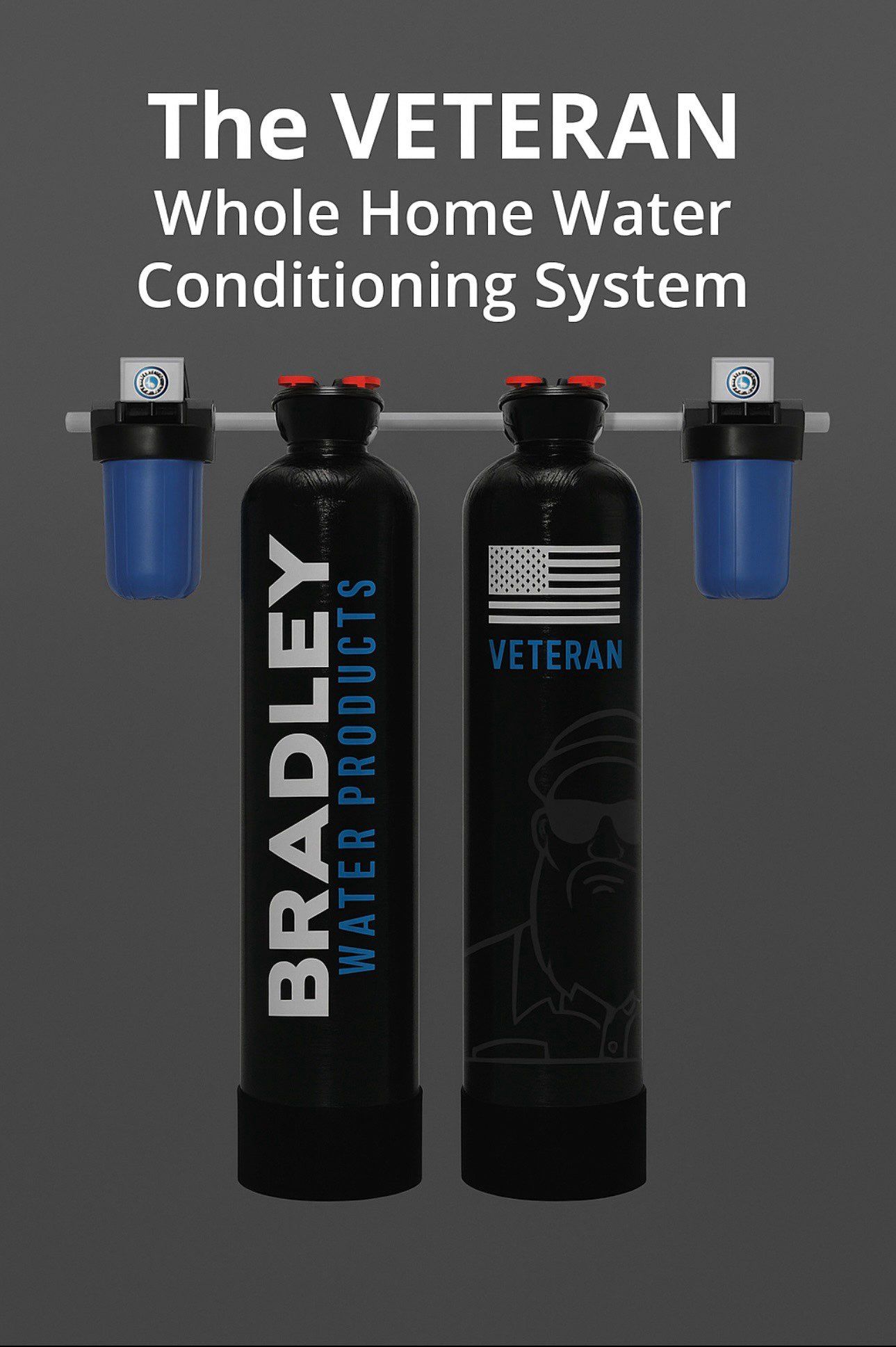
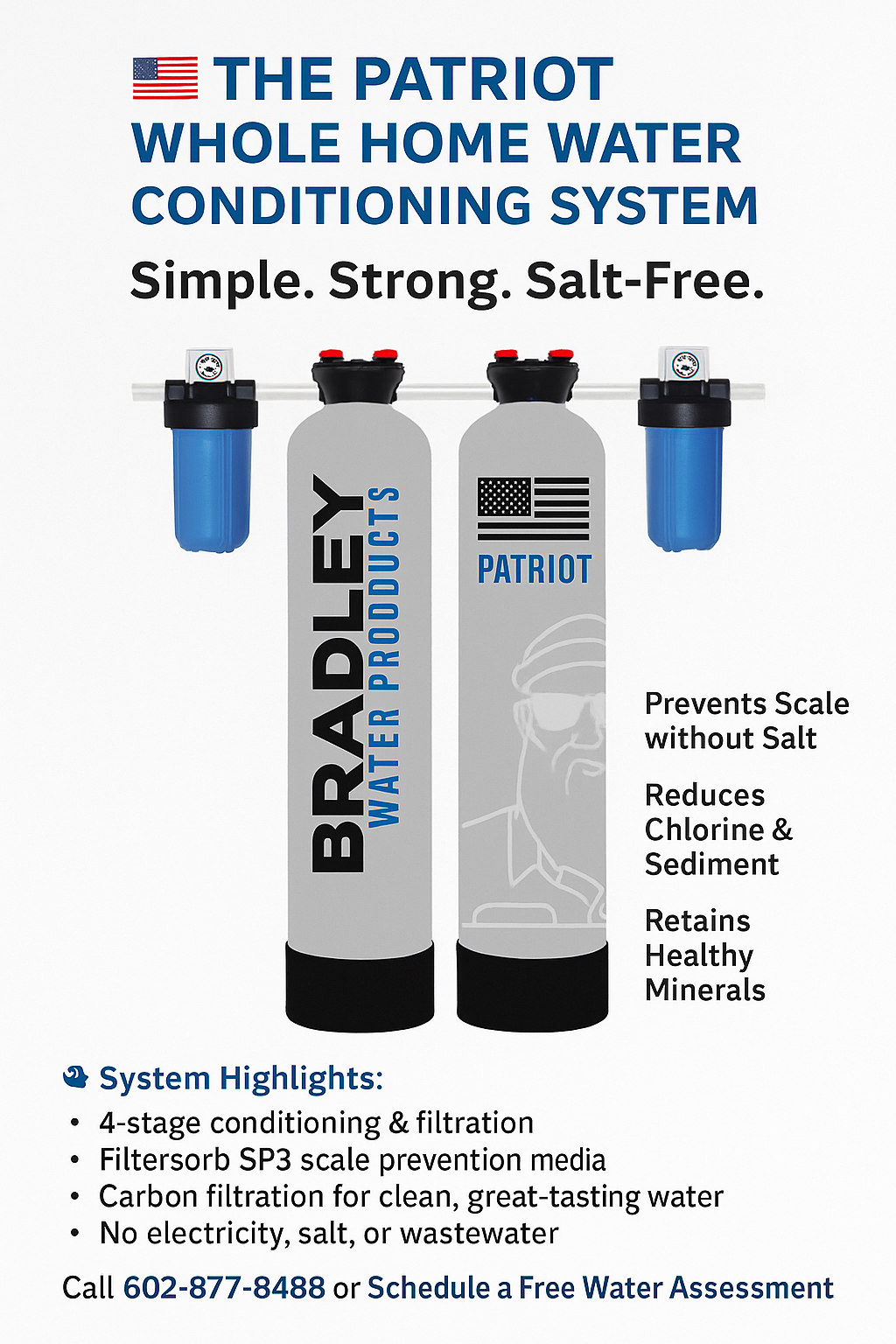
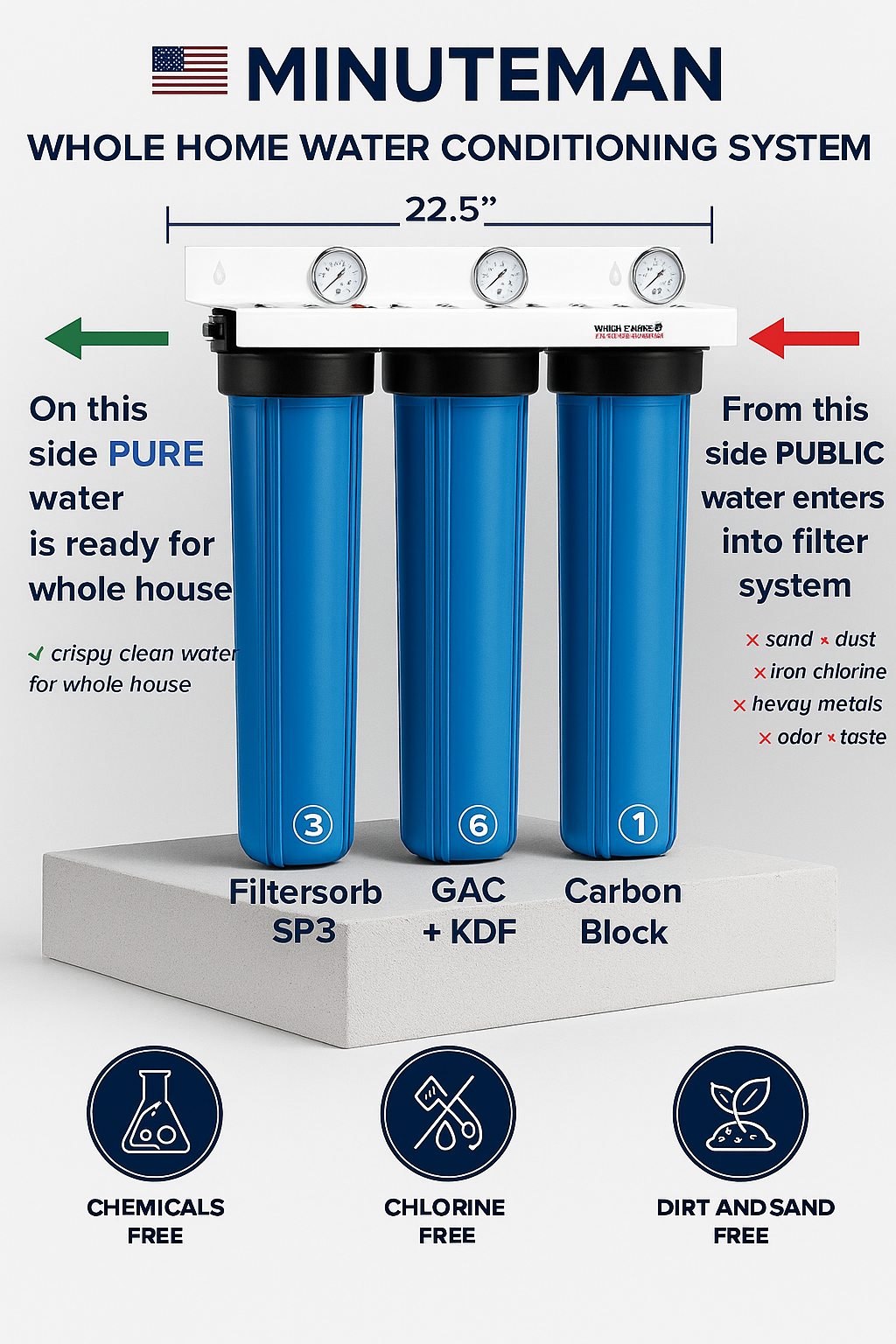
Every Bradley Water Products system is engineered to address the unique challenges of Arizona’s water supply. Whether you choose our Veteran, Patriot, or Minuteman system, you’ll receive a professionally designed solution that combines premium filtration with advanced salt-free water conditioning to deliver cleaner water, protect your plumbing investment, and improve water quality throughout your entire home
these products are exclusive to Bradley Water Products
| Feature / System | VETERAN | PATRIOT | MINUTEMAN |
|---|---|---|---|
| System Type | Multi-tank | Multi-tank | Cartridge-based |
| Number of Stages | 4 | 4 | 3 |
| Pre-Filter (5 Micron) | Yes | Yes | No (Uses Carbon Block) |
| Post-Filter (5 Micron) | Yes | Yes | No |
| Carbon Filtration | GAC + Coconut Shell | GAC + Coconut Shell | Carbon Block (Stage 1) |
| KDF Media | Yes | No | Yes (Stage 2) |
| Polyphosphate Beads | Yes | No | No |
| Filtersorb SP3 Media | Yes | Yes | Yes (Stage 3) |
| Scale Prevention | Salt-Free (SP3 + Polyphosphate) | Salt-Free (SP3 only) | Salt-Free (SP3 only) |
| Removes Chlorine / VOCs | Yes | Yes | Yes |
| Removes Heavy Metals | Yes (KDF) | No | Yes (KDF) |
| Bacteria Growth Inhibition | Yes (KDF) | No | Yes (KDF) |
| Ideal For | Large homes with max protection | Homes wanting strong scale + filtration | Smaller homes or low-maintenance installs |
| Footprint | Large | Medium | Compact |
| Maintenance | Low | Low | Moderate (cartridge changes) |
| Wastewater / Backwash | No | No | No |
| Salt / Chemicals Required | No | No | No |
| Power Required | No | No | No |
| Installation Type | Pro install recommended | Pro install recommended | Wall or floor mount, pro recommended |
Here's a comparison chart that reflects what each media is actually designed to remove or reduce. Keep in mind that performance depends on water chemistry, contact time, flow rate, and the specific carbon or membrane used.
| Contaminant | Activated Carbon (GAC) | Coconut Shell Carbon | KDF-55 Media | Reverse Osmosis (RO) |
|---|---|---|---|---|
| Chlorine | ✅Excellent | ✅Excellent | ✅Excellent | ✅Removes |
| Chloramine | ⚠️Limited (special catalytic carbon works better) | ⚠️Limited | ⚠️Partial | ⚠️Partial (best with carbon prefilter) |
| Bad Taste & Odors | ✅Excellent | ✅Excellent | ❌ | ✅Excellent |
| VOCs (solvents, gasoline, pesticides) | ✅Excellent | ✅Excellent | ❌ | ✅Most |
| PFAS ("Forever Chemicals") | ✅Many types | ✅Many types | ❌ | ✅Excellent |
| Lead | ⚠️Some reduction | ⚠️Some reduction | ✅Excellent | ✅Excellent |
| Mercury | ⚠️Some reduction | ⚠️Some reduction | ✅Excellent | ✅Excellent |
| Arsenic | ❌No | ❌ | ⚠️Limited (depends on water chemistry) | ✅Excellent |
| Chromium | ❌ | ❌ | ⚠️Partial | ✅Excellent |
| Copper | ❌ | ❌ | ✅Good | ✅Excellent |
| Iron | ❌ | ❌ | ✅Excellent | ⚠️Membrane can foul if untreated |
| Hydrogen Sulfide (rotten egg smell) | ⚠️Some | ⚠️Some | ✅Excellent | ❌No |
| Scale (calcium & magnesium) | ❌ | ❌ | ❌ | ✅Removes |
| Sodium | ❌ | ❌ | ❌ | ✅Removes |
| Nitrates | ❌ | ❌ | ❌ | ✅Excellent |
| Fluoride | ❌ | ❌ | ❌ | ✅Excellent |
| Microplastics | ✅Most | ✅Most | ❌ | ✅Excellent |
| Sediment (with carbon block) | ✅Yes | ✅Yes | ❌ | ✅Yes (prefilter required) |
| Bacteria | ❌ | ❌ | ⚠️Inhibits bacterial growth in filter | ⚠️Some removal, not sterilization |
| Viruses | ❌ | ❌ | ❌ | ⚠️Some removal, not guaranteed |
| Protozoan Cysts (Giardia, Cryptosporidium) | ❌ | ❌ | ❌ | ✅Yes (properly functioning membrane) |
| Dissolved Salts/TDS | ❌ | ❌ | ❌ | ✅Excellent (95–99% typical) |
What each media does best
Activated Carbon (GAC)
- Chlorine removal
- Taste and odor improvement
- VOCs
- Many organic chemicals
- Some PFAS
Coconut Shell Carbon
- Everything standard activated carbon does
- Generally has a higher micropore volume, making it especially effective for:
- Chlorine
- Taste and odor
- Low-molecular-weight organic compounds
- Commonly used in drinking water applications because of its high adsorption efficiency.
KDF-55
- Chlorine removal through a redox reaction
- Heavy metals (lead, mercury, nickel, chromium)
- Iron
- Hydrogen sulfide
- Helps control scale formation
- Inhibits bacteria, algae, and fungi from growing inside the filter media
Reverse Osmosis
- Dissolved salts (TDS)
- Arsenic
- Fluoride
- Nitrates
- Lead
- Chromium
- Copper
- PFAS
- Microplastics
- Most bacteria and protozoan cysts
- Significantly reduces many other dissolved contaminants
Why the Veteran, Patriot, and Minuteman Water Conditioning Systems Complement a Reverse Osmosis System
The Veteran, Patriot, and Minuteman Whole Home Water Conditioning Systems are designed to improve the quality of the water used throughout your entire home. While each system offers a different level of filtration and conditioning, they all serve the same primary purpose—treating the water as it enters your home to help protect your plumbing system, water heater, fixtures, and appliances while providing cleaner, better-quality water for everyday use.
Each system helps reduce sediment, chlorine, chloramines (where applicable), unpleasant tastes and odors, and many volatile organic compounds (VOCs). Depending on the model, they also incorporate advanced filtration media such as KDF and/or Filtersorb SP3 to help reduce certain heavy metals and protect plumbing from scale buildup without the use of salt.
A Reverse Osmosis (RO) system serves a different purpose. Installed at a dedicated drinking water faucet, an RO system provides an additional level of purification for the water you drink and cook with. RO technology is highly effective at reducing many dissolved contaminants that whole-home systems are not designed to target, including dissolved salts, arsenic, fluoride, nitrates, lead, PFAS (depending on the specific RO membrane and system design), and many other dissolved impurities.
When paired together, your whole-home conditioning system and an RO system provide comprehensive water treatment.
Veteran Whole Home Water Conditioning System: Delivers the highest level of whole-home treatment by combining sediment filtration, advanced carbon filtration with KDF, Filtersorb SP3 scale protection, and post-filtration to provide exceptional water quality throughout the home while helping maximize the performance and lifespan of the RO system.
Patriot Whole Home Water Conditioning System: Provides excellent whole-home filtration with advanced carbon media and Filtersorb SP3 scale protection, helping improve water quality throughout the home and supplying cleaner water to the RO system for optimal performance.
Minuteman Whole Home Water Conditioning System: Offers an efficient, compact multi-stage cartridge filtration system that reduces sediment, chlorine, and other common contaminants while helping control scale, making it an excellent whole-home companion to a Reverse Osmosis drinking water system.
By removing sediment, chlorine, and many contaminants before the water reaches the RO system, all three whole-home systems help extend the life of the RO membrane, reduce maintenance, and improve overall system performance. The Reverse Osmosis system then provides exceptionally pure, great-tasting drinking water by removing contaminants at the molecular level that whole-home systems are not intended to remove.
Whether you choose the Veteran, Patriot, or Minuteman, pairing your whole-home water conditioning system with a Reverse Osmosis system provides the best of both worlds: cleaner, conditioned water throughout your home and premium-quality drinking water at the tap.
How Our Salt-Free Descaling Technology Works
At Bradley Water Products, our advanced water conditioning systems use a combination of Natural Assisted Crystallization (NAC) and polyphosphate technology to help protect your plumbing system, fixtures, water heater, and appliances from the damaging effects of hard water scale—without the use of salt.
Natural Assisted Crystallization (NAC)
Natural Assisted Crystallization (NAC) is an advanced, salt-free water conditioning technology designed to help reduce the harmful effects of hard water while retaining the beneficial minerals naturally found in your water.
Unlike a traditional salt-based water softener, an NAC system does not remove calcium and magnesium. Instead, as water passes through the Filtersorb® SP3 media, these hardness minerals are converted into microscopic, stable crystals. These tiny crystals remain suspended in the water and are much less likely to attach to plumbing, fixtures, water heaters, or other household appliances as hard scale.
Polyphosphate Protection
Polyphosphate provides an additional layer of scale protection by conditioning hardness minerals and helping keep them suspended in the water. This reduces their tendency to bond together and adhere to metal surfaces, helping minimize scale formation inside pipes, water heaters, fixtures, and appliances.
Polyphosphate also helps reduce the staining effects associated with small amounts of dissolved iron and manganese that may be present in some water supplies. In addition, it can help reduce corrosion inside plumbing systems by forming a thin, protective barrier on the interior surfaces of metal pipes.
Two Technologies Working Together
By combining Filtersorb® SP3 (NAC) with polyphosphate, our systems utilize two complementary technologies that work together to help reduce scale formation throughout your home.
NAC converts hardness minerals into stable microscopic crystals that are much less likely to stick to surfaces.
Polyphosphate helps keep minerals dispersed in the water while providing additional protection against scale and corrosion.
Together, these technologies help protect your plumbing system, fixtures, water heater, and appliances without the need for salt, electricity, or regeneration cycles.
Benefits of Our Salt-Free Water Conditioning Systems
Salt-free operation
No regeneration cycles
No wastewater discharge
No electricity required
Helps reduce scale buildup throughout your home
Helps extend the life of plumbing, fixtures, water heaters, and appliances
Helps reduce staining from low levels of iron and manganese
Helps reduce corrosion in metal plumbing systems
Retains naturally occurring calcium and magnesium
Lower maintenance than traditional salt-based softeners
What Our Systems Do—and Don’t Do
Our salt-free water conditioning systems are designed to help prevent new scale from forming and may gradually reduce the adhesion of existing scale over time under many conditions. They are not water softeners and do not remove hardness minerals from the water.
Because calcium and magnesium remain in the water:
Water hardness is not reduced.
Total Dissolved Solids (TDS) remain essentially unchanged.
Calcium and magnesium are retained.
Water tests will continue to show hard water.
Instead, the minerals are conditioned so they are far less likely to form damaging scale throughout your plumbing system.
The Bradley Water Products Difference
Our Veteran, Patriot, and Minuteman Whole Home Water Conditioning Systems are engineered specifically for Arizona water. By combining premium filtration with advanced scale-control technologies, they help deliver cleaner, better-quality water while protecting your home’s plumbing system and appliances.
The Veteran and Minuteman systems combine Filtersorb® SP3 with polyphosphate for enhanced scale protection. The Patriot system utilizes Filtersorb® SP3 to provide effective salt-free scale control with a simplified design.
The result is cleaner water throughout your home, reduced maintenance, and long-term protection for the plumbing system you rely on every day.
